
How is LUMO fNIRS different from conventional fNIRS systems?
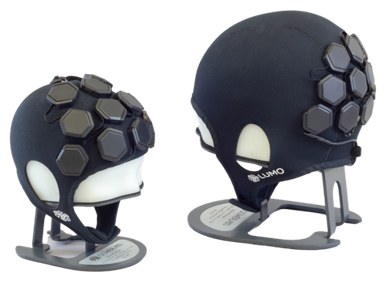
By fusing high-density diffuse optical tomography (HD-DOT) with a lightweight, fiberless, and modular architecture, LUMO is a major improvement over traditional functional near-infrared spectroscopy (fNIRS) systems. While conventional fNIRS systems usually depend on fixed source-detector distances and sparse optical fiber arrays, LUMO provides wearable, high-density brain imaging with better spatial information and easier setup.
High-Density Diffuse Optical Tomography (HD-DOT)
Conventional fNIRS systems typically employ fixed source-detector distances and sparse arrays of optical fibers, which restrict spatial resolution and frequently necessitate time-consuming setup processes.
LUMO fNIRS, on the other hand, provides significantly richer spatial information while still being wearable by reconstructing three-dimensional cortical activation maps using HD-DOT algorithms and dense, overlapping measurements at multiple source-detector separations.
Fibreless Modular Architecture
LUMO's fiberless modular tile design is among its most notable innovations. Each lightweight hexagonal sensor tile incorporates its own light sources, detectors, and electronics in place of large fiber bundles that are connected to an external console.
Because these tiles can be placed anywhere on specially made headgear, researchers can image anything from a single cortical region to the entire cortex.
In addition to making setup easier, this modular approach allows labs to grow their systems as research needs change without having to replace current hardware.
Lightweight Design and Faster Setup
Another significant benefit is participant comfort. Optical fiber bundles can make conventional fiber-based systems heavy and constrictive, which makes movement studies challenging and frequently lowers participant compliance during lengthy experiments.
By substituting lightweight headgear that can usually be fitted in less than 60 seconds, LUMO fNIRS gets rid of these heavy fibers.
Additionally, the system includes interchangeable light guides that maximize comfort for adults, children, infants, and neonates while maintaining good optical coupling across various hair types.
Key Differences Between LUMO and Conventional fNIRS
HD-DOT technology enables three-dimensional cortical activation mapping.
Dense, overlapping measurements provide richer spatial information than sparse optical fibre arrays.
Fibreless modular sensor tiles integrate light sources, detectors, and electronics into lightweight hexagonal modules.
Expandable modular design allows researchers to scale the imaging area without replacing existing hardware.
Lightweight wearable headgear improves participant comfort and can typically be fitted in under 60 seconds.
Interchangeable light guides support good optical coupling across different hair types.
Wearable design enables brain imaging during walking, motor tasks, virtual reality, and natural social interactions.
Wearable Brain Imaging for Real-World Research
LUMO is intended for use in non-laboratory research. Because of its wearable design, participants can maintain high-quality brain imaging while walking, interacting, performing motor tasks, using virtual reality systems, or engaging in natural social interactions.
This makes it possible to conduct research in real-world settings that would be challenging or impossible with traditional fiber-based fNIRS systems.
If you’d like to dive deeper into any particular study or point, feel free to ask us at parag@tidentech.com or tidentech@gmail.com or call us on +91 9987442274.
Tiden Technologies
For both academic and commercial uses, Tiden Technologies is a top supplier of cutting-edge neuroscience, eye tracking, biosensing, and human behavior research technologies.